We have very little information about the author of this story, other than the following review of another title, which appeared in a copy of To-day from 1897:
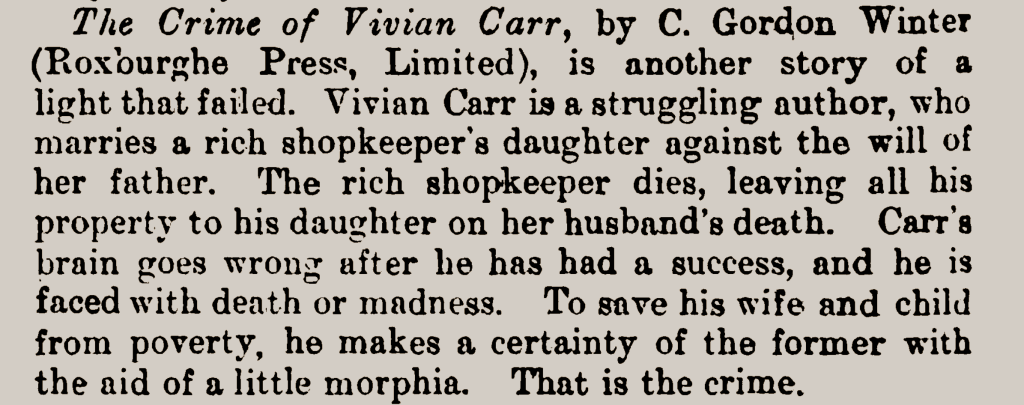
Intriguingly, the author of this book is sometimes credited as “C. Gordon Winter (Jean de Mézailles)”, implying that he wrote under both names. That would suggest a link to the following notice in an 1895 issue of the Saturday Review:
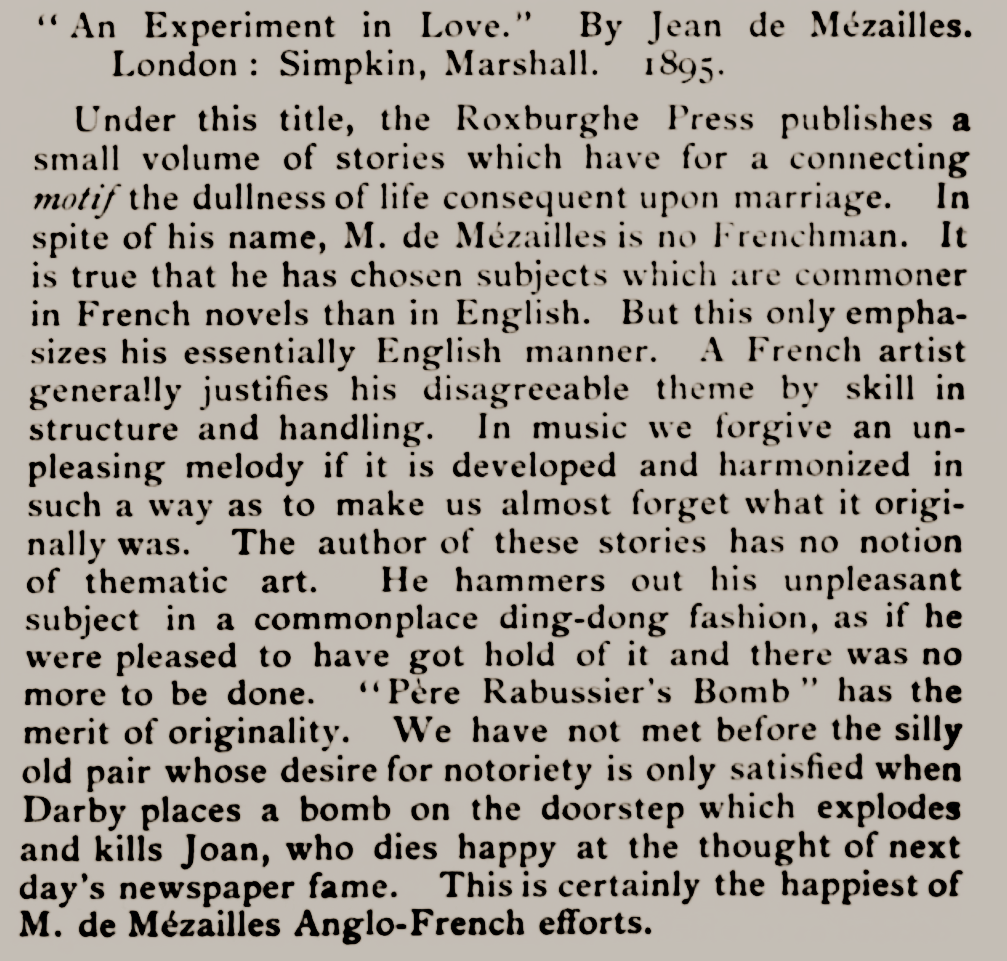
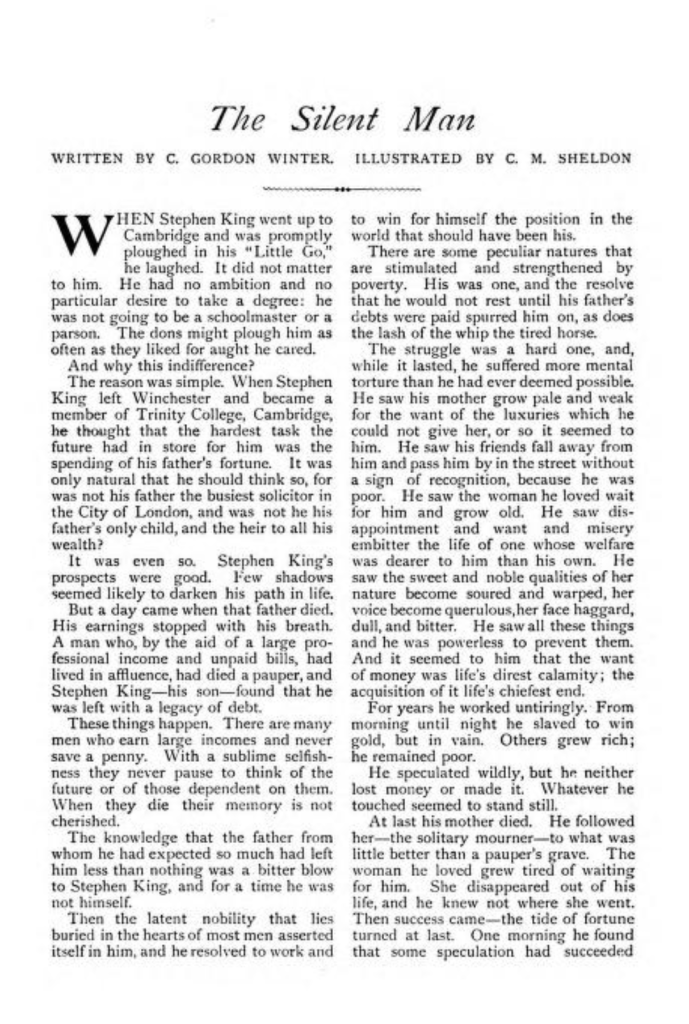
Amusingly, the unimpressed reviewer is thought to be none other than H. G. Wells. We’ll probably never know what he thought of “The Silent Man”, which we found in the Ludgate and reproduce here for your enjoyment.
Blogger’s note: if you find the opening sentence incomprehensible, you might like to know that being “ploughed in your Little Go” meant failing your second year exams, in the Cambridge slang of the time.
As always, we’ll be posting many short stories like this one, so make sure you follow us and check in regularly.
When Stephen King went up to Cambridge and was promptly ploughed in his “Little Go,” he laughed. It did not matter to him. He had no ambition and no particular desire to take a degree: he was not going to be a schoolmaster or a parson. The dons might plough him as often as they liked for aught he cared.
And why this indifference?
The reason was simple. When Stephen King left Winchester and became a member of Trinity College, Cambridge, he thought that the hardest task the future had in store for him was the spending of his father’s fortune. It was only natural that he should think so, for was not his father the busiest solicitor in the City of London, and was not he his father’s only child, and the heir to all his wealth?
It was even so. Stephen King’s prospects were good. Few shadows seemed likely to darken his path in life.
But a day came when that father died. His earnings stopped with his breath. A man who, by the aid of a large professional income and unpaid bills, had lived in affluence, had died a pauper, and Stephen King—his son—found that he was left with a legacy of debt.
These things happen. There are many men who earn large incomes and never save a penny. With a sublime selfishness they never pause to think of the future or of those dependent on them. When they die their memory is not cherished.
The knowledge that the father from whom he had expected so much had left him less than nothing was a bitter blow to Stephen King, and for a time he was not himself.
Then the latent nobility that lies buried in the hearts of most men asserted itself in him, and he resolved to work and to win for himself the position in the world that should have been his.
There are some peculiar natures that are stimulated and strengthened by poverty. His was one, and the resolve that he would not rest until his father’s debts were paid spurred him on, as does the lash of the whip the tired horse.
The struggle was a hard one, and, while it lasted, he suffered more mental torture than he had ever deemed possible. He saw his mother grow pale and weak for the want of the luxuries which he could not give her, or so it seemed to him. He saw his friends fall away from him and pass him by in the street without a sign of recognition, because he was poor. He saw the woman he loved wait for him and grow old. He saw disappointment and want and misery embitter the life of one whose welfare was dearer to him than his own. He saw the sweet and noble qualities of her nature become soured and warped, her voice become querulous, her face haggard, dull, and bitter. He saw all these things and he was powerless to prevent them. And it seemed to him that the want of money was life’s direst calamity; the acquisition of it life’s chiefest end.
For years he worked untiringly. From morning until night he slaved to win gold, but in vain. Others grew rich; he remained poor.
He speculated wildly, but he neither lost money or made it. Whatever he touched seemed to stand still.
At last his mother died. He followed her—the solitary mourner—to what was little better than a pauper’s grave. The woman he loved grew tired of waiting for him. She disappeared out of his life, and he knew not where she went. Then success came—the tide of fortune turned at last. One morning he found that some speculation had succeeded beyond his wildest hopes, and he returned to his comfortless lodgings that night a rich man.
He felt no pleasure at what had happened. Wealth had come to him too late, since it could not bring happiness to those he loved. He paid off his father’s debts—the debts which had killed his mother and spoilt his own life. But he did not rest content with what he had made. Men around him traded body and soul for gold, and from them he caught the fever of gain. It gripped him strongly. He did not want more money, yet he toiled and worked as hard for it as he had done twenty years ago. Each day he grew richer. Everything he touched turned to gold, and, like all about him, he went to fame over broken promises and the misery of hundreds who had trusted him.
His fortune doubled itself each month. He became a millionaire. Men who called themselves his friends crowded round him, and he—Stephen King, the lonely, broken-hearted man—was styled the “Napoleon of Finance.”
One afternoon he left the city, the richest man in England. He had successfully brought off a giant coup. Thousands were ruined by it, but he whose subtle brain had organised it and carried it through after many weeks of ceaseless toil, had gained such wealth as could buy up kingdoms. His face was calm and his eyes were dull and heavy as, amidst the congratulations of those who surged around him, he left the house and walked down the street.
He did not notice his carriage that was waiting for him, but, through sheer force of habit, hailed an omnibus and stepped into it. He bought an evening paper and saw that his triumph was proclaimed therein in large letters. He smiled faintly as he read through the paragraph which hailed him in eulogistic terms as the Creosus of the nineteenth century. How little it meant to him! His eyes darkened, and the crowded, flaring streets became blurred to him as he thought of the past and of the happiness which his enormous wealth would once have brought him.
He got out of the omnibus at thebottom of Park Lane, walked up thestreet, and let himself into the stately house that for six months past had been his home. A thin rain was beginning to fall, and the streets looked empty and cheerless; he shivered as he shut the front door. Then he went into his cosy library and sat down before the writing table which was littered with papers.
Mechanically he drew his cheque-book from his pocket, and, tearing a leaf out of it, wrote a cheque to bearer for £500,000. He smiled as he signed it, thinking idly how little it would disturb him if someone else held it, for it did not represent one-fortieth of his entire fortune. He pushed the cheque on one side; he would send it to some charity to-morrow.
The shadows crept into the room and chased away the twilight. Stephen King leant his head on his hand and thought. Of what use was this boundless wealth to him? What could he get with it? What did other men get? Nothing worth the having. What could it bring him? Nothing at all. It didn’t bring him rest; it could not even allay the pain of thought. He would give all for one moment’s peace. He felt strangely ill and tired—wearied in body and soul. He was certainly ill, his brain was in a whirl, it seemed as though a sledge-hammer was beating it into pulp, and a noise—as though a thousand gongs were clashing in his head—seemed to be driving him mad. The room was becoming hazy and indistinct, all power of thought seemed to have left him, and a black mist came before him and shut out the red glow of the fire from his eyes. He sank back in his chair… his head pained him… it was more than he could bear, the noise inside it increased… it would kill him… would it never cease?… a roar and a crash, as though the earth had split asunder, and then came utter, blessed peace… He pillowed his head on his arms, his eyes closed and he fell asleep… and all was black as night…
Gradually the darkness lifted, and Stephen King looked up and found that he was sitting by a man who was—himself. It was strange, impossible Such things did not happen in real life. But he was asleep and dreaming, and in dreams all things are possible.
Yet it was strange to be dreaming like this: he had not dreamt for years. It reminded him of his childhood. When quite young he had, like many children, suffered from too realistic dreams of horror, wherein he saw himself driven by nightmare destiny from one position of danger and disgrace to the next, seeing himself as another being, enduring that being’s torments and dishonour, yet powerless all the while to give aid or advice.
And now it seemed that his childish nightmare had returned to him after all these years. But what a strange dream it was! It had nothing to do with gold mines or railways.
Resigned to the phantom terrors that the dream undoubtedly had in store for him, he watched himself with a certain interest. He was in a hansom, seated by the other Stephen King, and they seemed to be driving rapidly eastwards. His own knowledge of London only extended as far as the City. The great East End was an unknown world to him, and he gazed about him curiously as he passed through dimly-lighted streets and foul slums, where want and misery were so apparent.
On, on they rolled, he and the Man at his side, past gaunt, black-shadowed archways and dingy little houses, with square holes for windows.
Squalid women stared at him with bleared eyes, and called after him with harsh laughter; children huddled together on the doorsteps, and sought shelter from the cold rain; drunkards staggered about.on the slippery pavement, and reeled.out of the way of the horse, shaking their fists at it and muttering curses. A mournful silence prevailed, save where a short fight was taking place outside a beer-shop, and a crowd had gathered round the combatants, urging them on with oaths and cries. The gas-light, burning dimly at the corner of the street, cast flickering shadows on their sallow faces. It was all wonderfully life-like, and Stephen King shuddered as he saw.these things, but the Man at his side saw nothing; ever silent, he gazed before him with vacant eyes. The moon hung low in the sky like a ball of amber, and from time to time a black cloud sailed across it and hid it from his view. The streets grew narrower and more gloomy; the few gas lamps, blurred by the damp mist, gave forth the faintest spark of light. At last the cab drew up at the top of a dark lane. The Silent Man descended. Stephen felt impelled to do the same. The cabman drove quickly away. All.that night Stephen remained by the other’s side. He could not leave him. Some horrible influence compelled him to follow the Man who was so like himself. The Man led him into strange places: he saw sights that sickened and disgusted him. The dream quite came up to the recollection of what his childish nightmares had been. He saw poverty, crime, and vice steal forth from their hovels and rub shoulders with him—Stephen King the millionaire. But they did not seem to notice him; they had eyes only for the Silent Man.
Together they went into low, evil-looking houses, where men and women sang, and drank, and danced until the night grew old with merriment. Sailors of all nations crept in like hunted animals; their cruel faces were sodden with drink, and they quarrelled with each other incessantly in queer, foreign tongues. And when the glare of the gas-lights began to pale before the grey dawn the Silent Man fell asleep in a chair. He had been drinking heavily, and his head was bent forward on his breast. Women looked at him and laughed.
Stephen gazed at him with tired eyes; he seemed to see himself as in a glass, and the reflection was not a pleasant one. He began to wish that he could wake up. The dream no longer interested him; it had lost the charm of novelty. And the women crept away, and the Silent Man slept on, until at length some sailors spied him and began to whisper to each other. After deliberating for a minute they came softly over to him, and began to feel in his pockets. Their eyes glittered, and a look of joy came into their cruel faces, for they found money in plenty. Gold, silver, and bank-notes they took from him.
At last one, more avaricious than the rest, unbuttoned the sleeping man’s coat and felt in the pockets of his waistcoat; he did this so roughly that the Man awoke, and, seeing that he was being robbed, sprang at the sailor who was bending over him. A sharp fight ensued. The Silent Man struggled desperately: he uttered no cry, but his eyes flashed like diamonds, and the veins in his forehead stood out like knotted cords. But he was like to be overpowered, for he was wrestling with four strong men. Stephen felt sorry that he was being worsted in the fight, and he longed to be able to help him, but he could not. A moment later he saw to his horror that the Silent Man had drawn a knife from his pocket and had stabbed the sailor who had robbed him. The man fell heavily.
Then the Silent Man breathed hard, and glared around him; he saw that the other sailors had taken long knives from their pockets and were coming towards him. With a spring like that of a wild cat he leapt at the nearest man and buried the blood-stained knife in his breast. The man staggered back, and sank into a chair with a deep groan. The Silent Man flung the knife on the ground and fled; and Stephen, glancing at it, saw that it had a quaint ivory handle, inlaid with gold and precious stones, and he recognised it as one that he had in his library at home.
He was horrified, but he told himself that it was but a dream, and he laughed at his bewilderment of the moment, and resigned himself to the old familiar position of onlooker at what he felt assured were the visionary fortunes of the Man who was so like himself. And so the dream went on with painful realism. He saw the Silent Man captured one night in a low lodging-house, and saw him later on tried for murder. He saw the dingy old court, the crowd of long-robed barristers, the grim face of the judge, and finally he heard the Silent Man condemned to death, and he felt sorry for him, for he knew that he was not really guilty of the awful crime of murder. But he whom he pitied seemed indifferent to the fate that awaited him; he neverbspoke a word, and his face was calm and impassive, as though it were a block of cold marble. Then, as the dream went on, he saw him sitting in his prison cell, and one morning he saw a man come in and bind his arms with rope, and a clergyman with a grave, sad face, spoke earnestly to him, but the Silent Man never answered a word; and they led him along a stone passage, and a bell tolled mournfully outside.
And Stephen, following behind him, began to be afraid, for he knew that the Silent Man was going to his death.
But he smiled to himself, for he remembered that it was but a vision, and he knew that he would soon wake up, and find everything as it had been when he fell asleep.
And he saw the Silent Man mount the gallows, and they put a white cloth over his head, and the clergyman prayed aloud.
And he was indeed afraid, and he said to himself, “I must awake!”
And then by a supreme struggle, by an effort of will which seemed to rend him through and through, Stephen King assembled his being, and brought together that part of him which had been the onlooker, and his physical self—not to find himself sitting in the shaded radiance of his study, but standing he knew not where.
He felt that something was over his face, shutting out the light of Heaven from his eyes, and he tried to put up his hands to take away the thing that was over his head, but he could not do so, for his arms were bound tightly to his side… He heard a man’s voice uttering prayers, and the deep tone of a bell fell on his ears. And Stephen King cried aloud in his agony, for he knew that that which he had dreamt had been no dream, but that the Silent Man was—himself.
 Creepy Old Stories